Your Sliding Door Is Telling You Something
Most sliding door problems announce themselves gradually. The door gets a little harder to open. A faint grinding noise starts. The lock feels stiff. Homeowners in Cape Haze, FL often live with these symptoms for months — sometimes longer — before calling for help. By that point, what could have been a straightforward roller swap or lock adjustment has frequently cascaded into damage affecting the track, the frame, and the glass seal. At Finest Cape Haze Sliding Door Repairs, we've seen every variation of deferred sliding door maintenance, and the pattern is consistent: the longer you wait, the more it costs to fix. Here are the five problems we respond to most often, and what's really going on behind each one.
1. The Door Is Hard to Open or Requires a Lift to Move
If you've started instinctively lifting the door panel slightly as you slide it open, your rollers are telling you they're done. Sliding door rollers are designed to carry the panel's weight effortlessly along the track. When the nylon or steel wheels develop flat spots, cracked edges, or bearings that no longer spin freely, the door loses that glide and starts dragging. The extra effort you're applying to compensate puts stress on the track, the frame, and the lock strike — all of which suffer accelerated wear as a result.
In Cape Haze's salt-air environment, roller bearings corrode faster than they do inland, and UV exposure degrades nylon wheel material over time. Our sliding door roller replacement service addresses this directly — we remove the door panel, extract the old roller carriages from the bottom rail, install correctly sized replacements with fresh bearings, rehang the door, and calibrate the height adjustment so the panel sits perfectly in its frame. Most homeowners are genuinely surprised at how effortless the door becomes after a roller swap. If the track has been damaged by the dragging rollers, we'll address that through our track repair and replacement service in the same visit.
2. The Lock Won't Latch Properly — or Feels Springy and Loose
A sliding door that won't latch securely isn't just inconvenient — it's a real security vulnerability, especially for seasonal Cape Haze residents who leave their properties unoccupied for months at a time. There are two common causes. The first is a worn or broken hook-bolt spring inside the lock body itself, which prevents the bolt from extending with enough force to seat in the strike keeper. The second is a door panel that has sagged or shifted off its proper alignment so the bolt can no longer reach the strike plate, even if the lock mechanism is functionally intact.
Both scenarios are straightforward to diagnose and fix with our sliding door lock and handle repair service. We carry hook-bolt lock bodies, keyed cylinders, flush-pull handles, and strike keepers for the most common door brands used in Southwest Florida construction. We also evaluate the door's overall alignment during every lock job — because installing a new lock in a sagging or misaligned door simply delays the problem rather than solving it. For doors serving Gasparilla Island estates or waterfront homes in Placida, we can also add secondary foot-bolt locks or Charlie bars for an extra layer of security during a single service call.
3. You Notice Drafts, Higher Electric Bills, or Bugs Getting In
If your air conditioning seems to run longer than it used to, or you're finding insects inside despite keeping the door closed, the weatherstripping around your sliding door has likely failed. The foam, vinyl, or pile seals that run along the door frame and panel edges compress and crack under Florida's relentless UV exposure and heat, leaving gaps that let conditioned air out and humid outside air — along with everything living in it — in.
This is particularly common in Cape Haze, where summer cooling season stretches from April through October and where salt air accelerates the degradation of seal materials that weren't rated for coastal conditions. Our sliding door weatherstrip and seal replacement service covers the full door perimeter — side jamb seals, top header seals, and the bottom sweep — using materials rated for prolonged UV and heat exposure. Addressing this early keeps your AC bill under control and prevents moisture from working its way into the door frame, where it can eventually cause structural damage that's far more expensive to correct.
4. The Glass Looks Cloudy or Foggy From the Inside
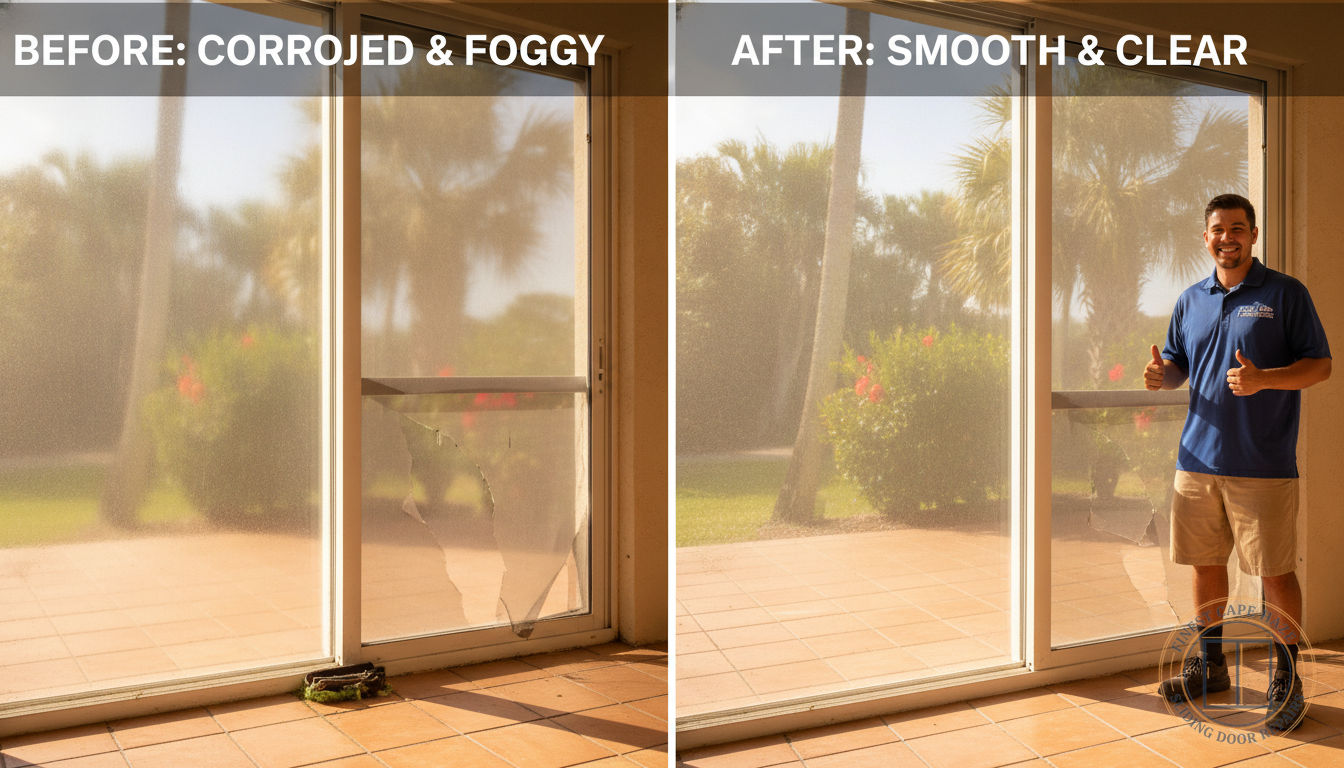
That milky, foggy appearance between the panes of your sliding door glass is a sign that the hermetic seal around your insulated glass unit (IGU) has failed. Once that seal breaks, moist air enters the space between the panes, depositing mineral residue that creates the hazy look you're seeing. It cannot be cleaned from the outside — the entire glass unit needs to be replaced to restore clarity. Beyond the aesthetics, a failed IGU also loses its insulating value, meaning your door is contributing to heat gain in an already warm Florida home.
Our sliding glass door panel replacement service handles the full swap — careful removal of the damaged panel, sourcing a correctly sized replacement (including impact-rated laminated glass for homes with that requirement), reinstallation with proper glazing tape and setting blocks, and a full roller and operation test before we leave. Many Cape Haze homes and neighboring properties in Rotonda West were built or upgraded with impact-rated sliders; we confirm the correct glass specification during our on-site assessment before ordering any replacement panel.
5. The Screen Door Falls Off Track or Has Torn Mesh
Sliding screen doors might seem like a low-priority item, but a screen door that constantly derails, falls out of its track, or has torn mesh is a daily frustration — and in Cape Haze's bug-friendly climate, a torn screen means no-see-ums and mosquitoes in your living room every time you want a cross breeze. Screen door frames bend when walked into, rollers wear out faster than glass door rollers because they're lighter-duty, and standard mesh degrades quickly under UV exposure and the attention of pets.
Our sliding screen door repair and replacement service covers everything from simple mesh restringing to full screen door frame replacement, including pet-resistant mesh upgrades for households with dogs or cats that push against the screen. We also replace worn rollers and top-rail guides so the screen door tracks consistently without popping out. When we're servicing a screen door, we always check the condition of the shared track surface to make sure any damage there isn't undermining the repair — if it is, we can handle a track cleaning and repair at the same time.
Don't Wait Until Small Problems Become Expensive Ones
All five of these problems have one thing in common: they're far cheaper to fix at first notice than after months of deferred attention. Finest Cape Haze Sliding Door Repairs is available Monday through Sunday, 8 AM to 6 PM, serving Cape Haze and surrounding communities including Rotonda, Grove City, and Englewood Beach. Call us at +1 (941) 415-6770 or email [email protected] the moment you notice your sliding door behaving differently. A quick assessment now almost always prevents a much larger repair later.
Discuss This With Our Team
Call +19414156770 or fill out our online form for a free, no-obligation quote.
Request Free Quote